


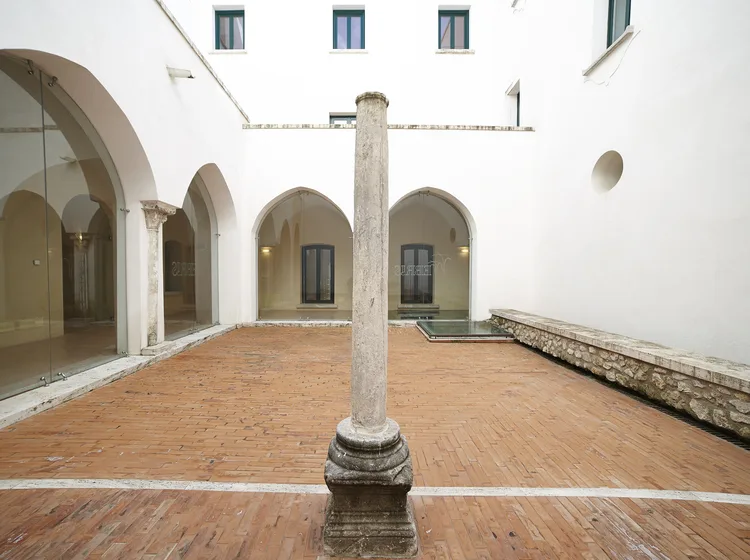
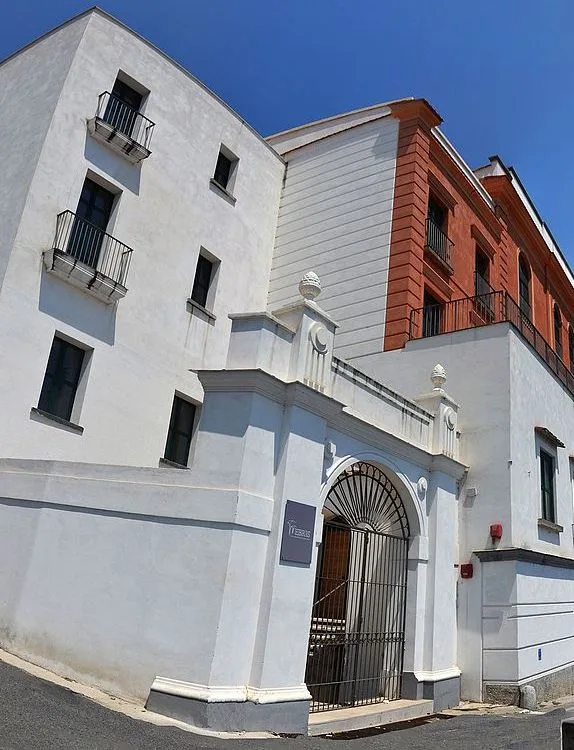
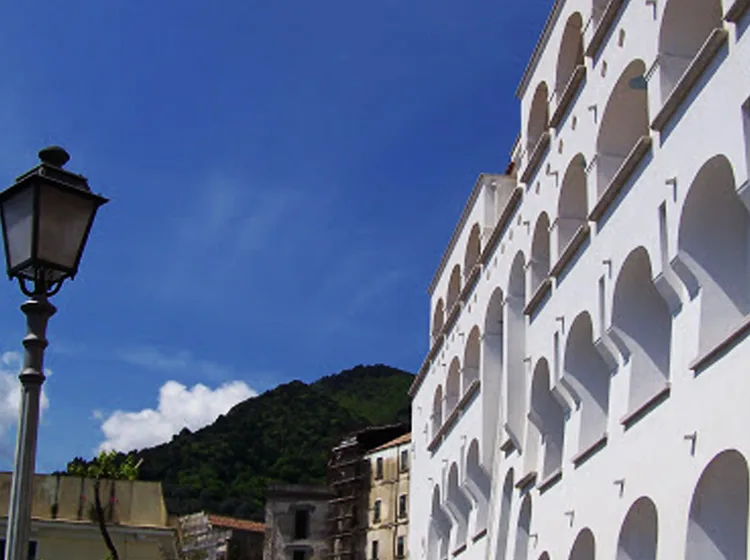
S. Nicola della Palma, surrounded by spring waters and lush gardens, dominates the city that stretches below its terrace overlooking the sea, has represented and still represents a fundamental place, whose events constitute a key to accessing multiple ‘histories’: that of Salerno, the Congregation cavense, the spread of the Observance movement in Campania and finally that of assistance to the sick

Convent of St. Nicholas of Palma
- Description
- Event
- News
- Gallery
- Contacts
- Map
- Opening hours
- Itineraries
S. Nicola della Palma, born in the second half of the 12th century in that area of the city that in medieval documentation is called Plaium montis, a large terrace that opens on the steep slope of the hill at the top of which rises the Lombard Castle. The church, soon flanked by a monastic complex, was founded around 1061 for the joint will of two characters of considerable thickness, Leo, according to abbot of the Benedictine monastery of the Holy Trinity of Cava dei Tirreni, and the gastaldo Vivo, an officer at the service of the last Lombard prince of Salerno, Gisulfo II. In St. Nicholas, therefore, the spiritual interests of guiding one of the main abbeys of southern Italy and those of an exponent of Lombard aristocracy were welded.
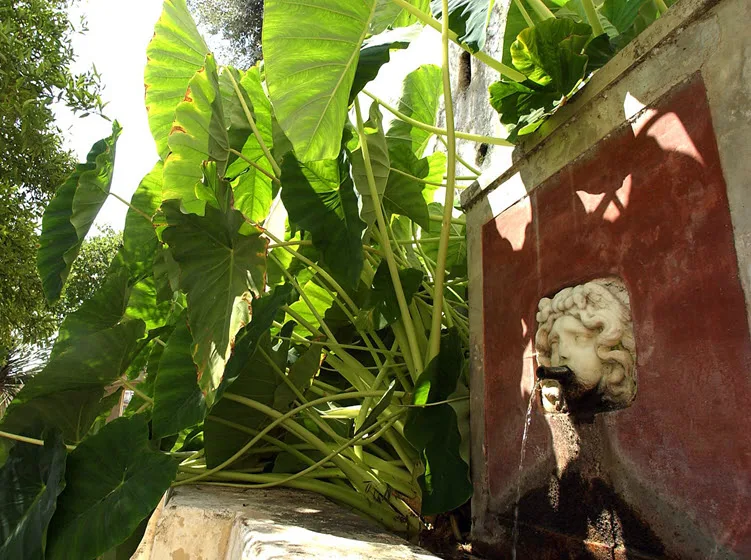
The site of the settlement of the new monastic foundation was peculiar; it was built in the vicinity of one of the countless springs that constellated the Plaium montis and the Bonadies hill. Despite last century the groundwater was affected by the construction of the railway tunnel of S. Lucia, still today the whole area is characterized by the presence of natural sources and lush gardens from these fed. A striking example is the Minerva Garden, one of the oldest botanical gardens and a good right among the most famous in the world. The source next to the cenobio, remembered in the documents as aqua que dissetur de Palma, is testified since 1057. The water that came from here, through a pipeline that crossed the city longitudinally, supplied various cenobi citizens, from the sides of the hill, to those near the sea.
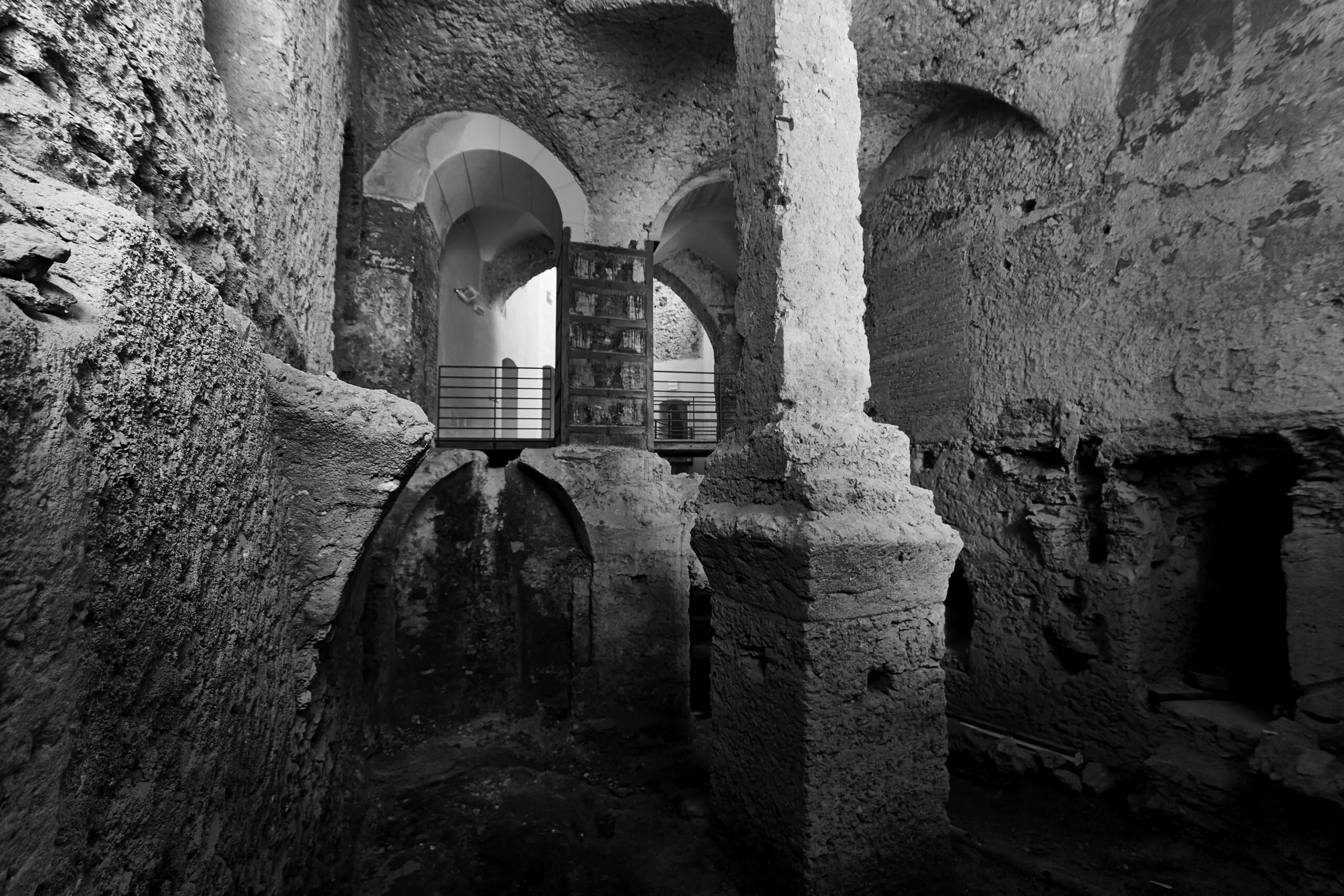
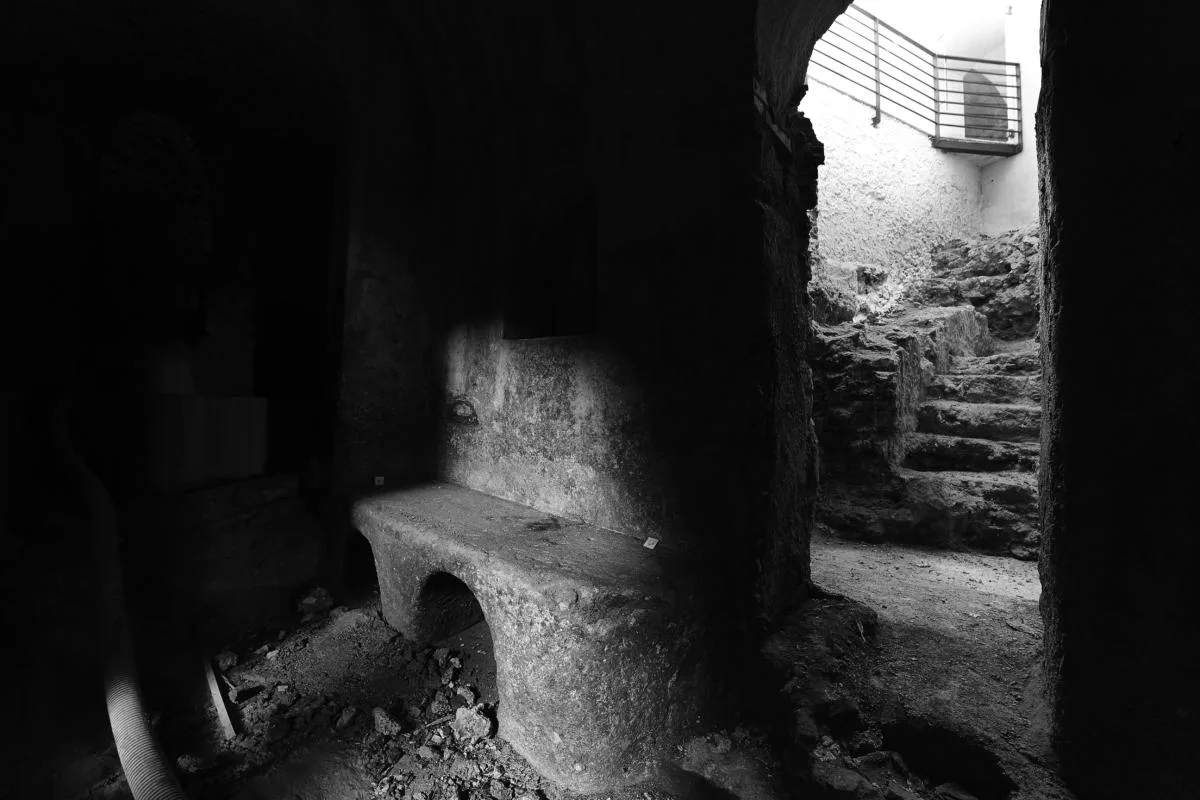
At the source of the Palma, the presence of a balneum is to be reconnected, i.e. a structure fed by the current waters intended for the washing of the body. Represented perfectly by the Roman thermae, this type of complexes did not cease to exist with the end of the ancient world but, now devoid of the complex articulation that had marked them earlier and passed under the control of religious institutions, bishops before and monasteries then, marked some territories even in the following period. It was the balneas to inherit the “termal” functions in the Middle Ages, when the act of washing assumed a particular religious and moral dimension and sometimes dichotomic. If, on the one hand, washing could take on characteristics connected with vice (to be evidently related to the nudity of the bodies), on the other hand, the act represented symbolically also the warning from sin before approaching sacred places or liturgical celebrations. Especially the use of
balneum was associated with curative approaches: not by chance in the Benedictine Rule, usually very circumspected towards washing, interpreted as a sign of softness if not of impurity, it was recommended to attend the balnea for the sick monks. As a result, the bath of St. Nicholas of Palma is a monument of invaluable importance, not only as a peculiar element in everyday life within the monastery but also because it represents one of the few and oldest testimonies of such structures of the medieval Mezzogiorno. Moreover, at the moment he is the only
monastic bathing which have substantial material traces within the city circuit of Salento, of which, as was said, the same monastery constituted a religious nucleus of no secondary importance. In February 1071, in fact, the archbishop of Salerno Alfano I allowed the religious to exercise some parish rights, such as the blessing of the Easter candle and the houses, the sprinkling with holy water, the visit of the sick, the acceptance of the dead in the abbey church and their burial. This is, therefore, extremely important religious functions which, usually, were of exclusive relevance to the prelate.
After the death of the noble Vivo, the monastery of St. Nicholas became part of the monastic network that led to the Holy Trinity of Cava de’ Tirreni, a small monastery born after the hermitic experience of the noble Salento Alferio and absurd soon at the center of a vast congregation extended throughout southern Italy. As a cenobius dependent on the caven abbey, the monastic community of St. Nicholas was led by a monk, the preposito before, the prior, then, directly subject to the abbot of the Holy Trinity. In addition to the discipline and guidance of the confreres, in accordance with the directives of the abbot, the religious dealt with the expansion, consolidation and defense of the monastic heritage.
The careful economic activity of the community concentrated in the acquisition of real estate in a territory that went from the immediate adjoining of the monastery, where the contus possessed, for example, part of a house with an oven (February 1070) and land with vines and chestnut trees (May 1074), to the area of vietrese and cavense, where in May 1094 the monastery acquired a portion of the land belongings of the deceased alive in March 1105 The most distant possessions, object of patrimonial interest by the monastery of St. Nicholas of Palma, insisted in the area that goes from the hilly region north of Salerno to the wide plains that extend east of the inhabited center, among the rivers Picentino and Tusciano. Above all, this last territory was particularly important in the agricultural properties of the monastery. Here, for example, in August 1080 John bought a land not sown at the price of 100 gold money, a very substantial sum, which on the one hand bears witness to the interest of the community for the area and on the other the economic availability of the same.
For the cultivation of these plots the monastery relied on tenants, to which the land was ceded for a longer or less long period, behind the commitment to cultivate it (and possibly to make improvements) and to annually pour a census in money or in nature or in both ways. Only to give some examples, the sources testify that in May 1151 the Preposito Paolo granted a land located within the city for a period of 19 years to an annual census of 4 dated; in October 1183, instead, the priore Notario gave a property for 12 years behind the co-responsion of the half of the produced wine and the cultivated fruits, besides 30 eggs and other contributions.
With the passage to the Swabian period and then angioin, until the beginning of the fifteenth century, it does not seem that substantial changes occurred in the organization and property structure of the monastery. In several documents, in January 1209, as well as in December 1294 and February 1363, the soggetion of the monastic community of Salerno is confirmed at the Abbey of the Holy Trinity of Cava.
At the end of the 13th century St. Nicholas of Palma also became a refuge for a female monastic community. In fact, as evidenced by an act of November 1285, on prayer of the Cardinal tied to the Apostolic See Gerard, bishop of Sabina, the abbot Leo II granted to Perna, abbess of the monastery of S. Paolo Sabina near Rome, who together with six sisters was directed to Capaccio, to stop in adjacent structures to the church of S. Nicola della Palma until the feast of S. Giovanni Battista capse was too much cause in that the residence Among other things, the granting act is particularly relevant, since it presents the list of sacred furnishings of the monastic church written at the time of the acceptance of the religious in the complex.
The Benedictine phase of the monastery of St. Nicholas of Palma suddenly ends around the beginning of the fifteenth century, when the cenobius was occupied by the Franciscan friars belonging to that religious reformist current within the Order, commonly called Observance. According to some Franciscan scholars the monastery came out of the congregation cavense and, in 1407, welcomed the friars by the will of Pope Gregory XII, who had received the instance of Queen Margherita of Durazzo, mother of King Ladislao, who died shortly there and was buried in the splendid funeral monument that is still present in the Cathedral of Salento. The form of religious life advocated by the beggar Orders, including the Franciscan Observants, was profoundly different from that experienced by the Benedictines: if for these the cloister was the heart of religious experience, for the friars the spiritual horizon opened to the world, in which to preach and implement its pastoral mission. For the Observants, whose ideal was the recovery of the ancient rigor of the Rule and of the Testament of St. Francis of Assisi, the perspective was therefore overturned: the whole world became a convent in which to carry out its apostolate.
This is, therefore, a very important moment in both religious and institutional history of the city since, on the other hand, if the traditional history of the settlement was confirmed, it would be one of the first testimonies of the Observants in the Campania Region. To date, however, still a lot of work remains to be done to deepen this moment of history of St. Nicholas of the Palma and the city of Salerno.
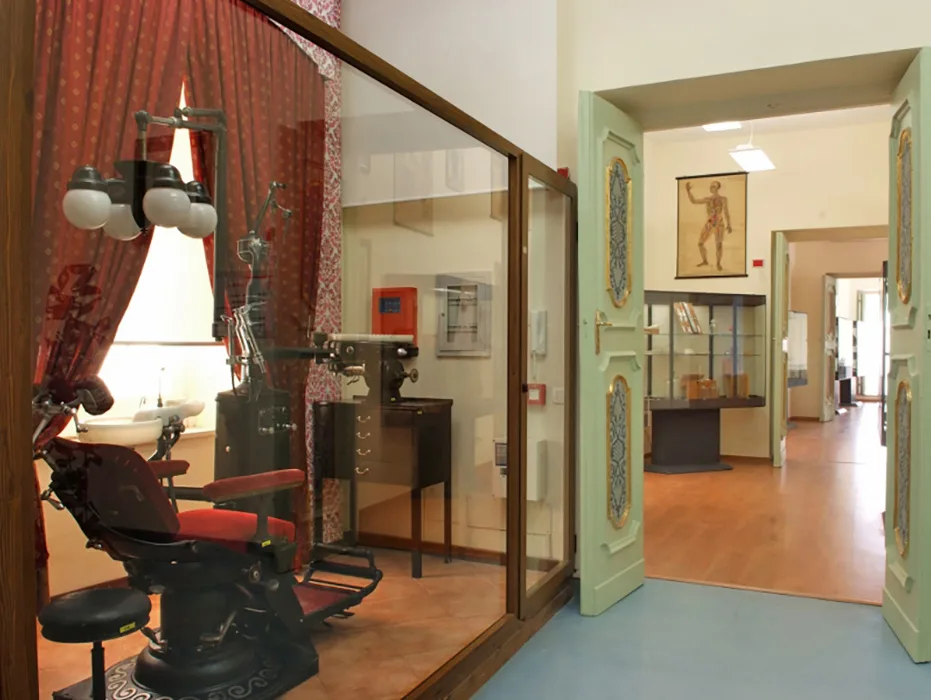
Of course it is known that the convent retained a significant role even after the settlement of the observant community, becoming in 1575, and for about twenty years, the seat of the curia of the newly-constituted minority province of Principato. But above all, it seems that St. Nicholas took on an important welfare function: the community was endowed, in fact, of a supplied spicery, probably useful to pharmacopathic activities related to the annexed infirmary, where they were admitted religious from the entire Province, attracting great fame for the quality of the treatment provided here, also witnessed by different testamentary legacies in favor of the structure.
If the religious experience of the convent has now ended, so it is not for the “medica” tradition of the complex, still carried out by the Ebris Foundation, which since 2012 has found its seat in the ancient monastery of Salerno, taking on the important burden of the protection and enhancement of the site, implemented also through the diffusion in favor of a wider public of the knowledge of the events that affected St. Nicholas of the Palma and the religious communities that inhabited it.
Loading…
Monday | visitable by reservation | |
Tuesday | visitable by reservation | |
Wednesday | visitable by reservation | |
Thursday | visitable by reservation | |
Friday | visitable by reservation | |
Saturday | visitable by reservation | |
Sunday | not accessible |
Cost: Free
Nessun itinerario disponibile.