'/%3E%3C/svg%3E)


With its arches on four levels, the monastery of San Lorenzo, of ancient foundation, dominates the panorama of the Old High Center.
 Salerno longobarda Artistic Historic
With its arches on four levels, the monastery of San Lorenzo, of ancient foundation, dominates the panorama of the Old High Center.
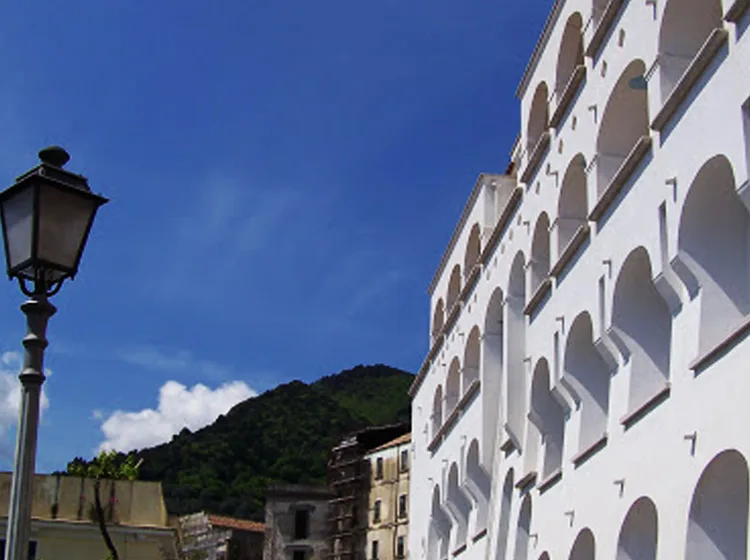
TheMonastery of San Lorenzois one of the oldest conventual sites in the areaPlaium Montis, high and far from the town but inside the city walls, on the only road that led toCastleand with an observation point of the coast from Agropoli to Capo d’Orso.
The first document that attests its presence dates back to 976, but many assume that it may have been erected on the ruins of an ancient Lombard palace.
At the end of theXII century the monastery knows a moment of great splendor and wealth: Pope Boniface VIII authorizes the daughter of the great ChancellorGiovanni da Procida, to move from the Convent of St. Spirit together with other sisters to introduce the rule of St. Clare. Giovanni da Procida is responsible for the restoration of the monastery.
In 1586, following a decree by Pope Sixtus V that shortens the monasteries, the clarisses are forced to abandon the St. Lawrence to join the monastery of St. Michael the Archangel, the nuns of the Pietà and of St. Spirit. The monastery decays into the structure, becomes asilo of malvivents and is depredated with the most precious ornaments.
In 1616the Reformed Fathers buy it and provide a new renovationon project laid out in 1620 by the Inggs. caves Matteo Vitale and Gioan Lonardo Caffaro and the Lombard Ing Camillo Migliaccio. The structure, elevated on four floors, is equipped with a smoother entrance and surrounded by vegetable garden – olive grove and garden. The access road is made wider and embellished with various fountains.
The work proceeds despite the numerous controversies with other religious orders related to the division wall with St. Nicholas, the use of water of various springs, the delimitation of some lands, the right of precedence in the processions.
In 1707 the library was built, located on the fourth floor of the building, in three adjacent rooms.
In 1811, due to Napoleonic decrees, the monastery was suppressed and a few years later restored, then finally suppressed in 1866 andattached to the nearby Orfanotrofio Provinciale Maschile,located in S. Nicola de Palma, which also becomes the legitimate owner.
On 16 October 1953 the Provveditore all’ Studi di Salerno announces to Orfanotrofio Umberto I the authorisation to open aart school with ceramist sectionwhich is placed on the top floor of S. Lorenzo. It is also organized with the M° Pasquale Avallone, in other premises of S. Lorenzo, aschool drawing optionalwho also declined to the compulsory insertion of the material in Professional Institutes and finally disappeared at the death of Avallone.
In 1954 part of themonastery and church are entrusted to the Franciscans of Piazza Ferrovia, while the remaining part remains owned by Umberto I and is used for civil housing. In October of the same year, on the occasion of the tremendous flood that affects Salerno and in particular the area of the Canalone, the building suffers serious damage and the friars are distinguished, with others, for the relief works provided since the first hours of the event.
In 1957, in some premises of S. Lorenzo, theclassrooms of a Section of the Ist. Prof.le Tranifor composers-linotypes and binders, in 1970 theReading Centre of Umberto Iand in 1979ceramic section of the art schoolreturn to the premises of the last floor . After being heavily damaged following the 1954 flood and the 1980 earthquake becameproperty of the Municipality of Salernothat, obtained a European financing, has implemented its restoration, making it the seat of its ownHistorical Archives.
Monday | : | : | |
Tuesday | : | : | |
Wednesday | : | : | |
Thursday | : | : | |
Friday | : | : | |
Saturday | : | : | |
Sunday | : | : |