


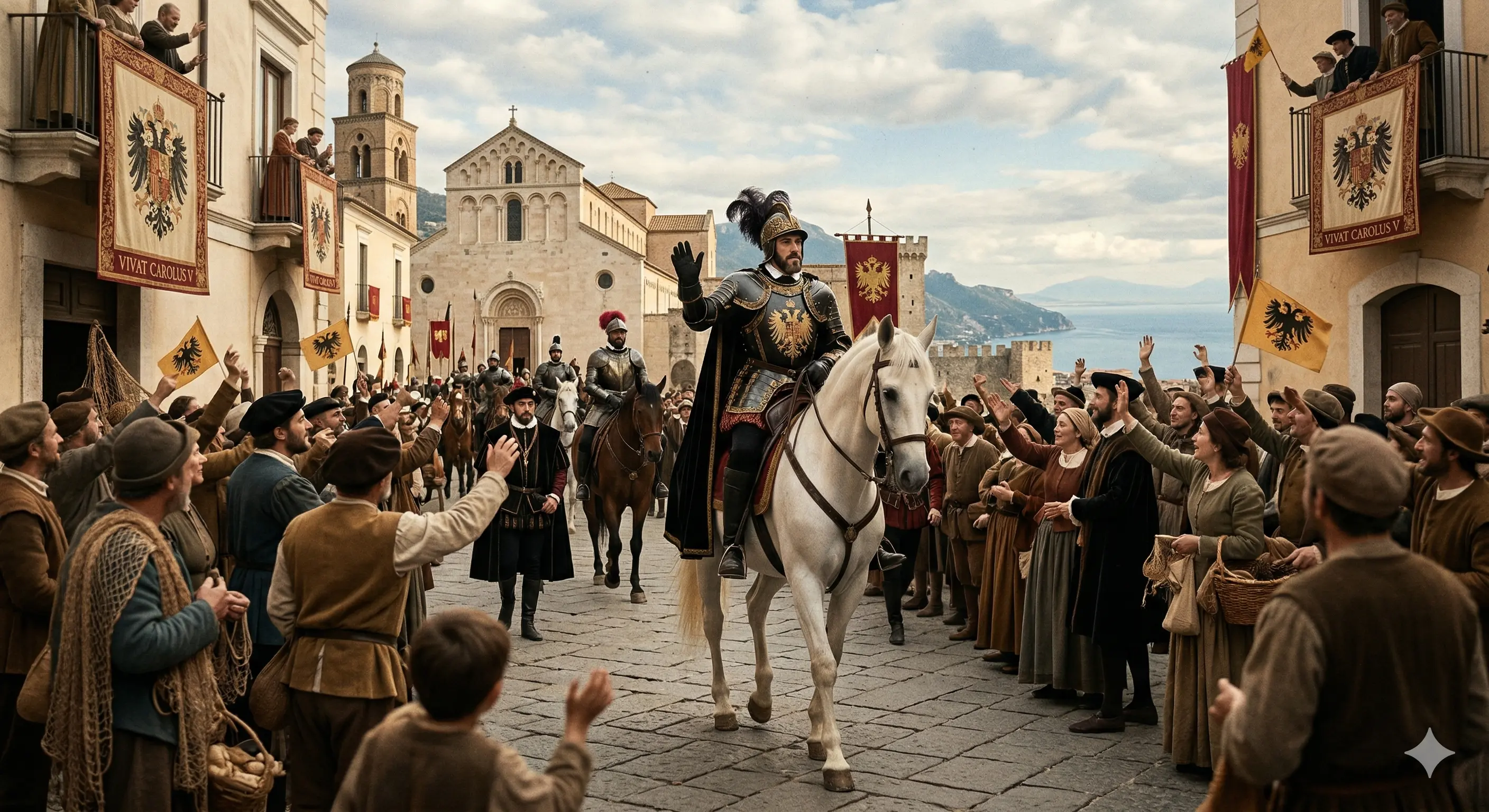
Carlo V on his journey to southern Italy, he crossed Salerno and was a guest of Prince Ferrante of Sanseverino, who cultivated a dream of cultural capital for the city.
Charles V, the Emperor of Habsburg, on whose reign the sun never went down, on 18 November 1535 visited Salerno.
The Emperor had made a victorious military expedition to Tunis, and as a conqueror and warrior, he decided to cross the southern part of his Kingdom to arrive in Rome and then continue for Northern Europe.
The journey lasted more than two months, touched Sicily longer, then crossed Calabria and entered the possessions of the Prince of Salerno, Ferrante di Sanseverino.
Between history and legend
At the Carthusian monastery of Padula there is a mythical frittata of a thousand eggs for the emperor who had stopped there to devote himself to a hunting trip, some historians tell of a stop in Salerno, guest of Palazzo Ruggi d’Aragona. Of course the prince of Salerno had organized the bell stage with great attention.
Resident between Naples (where he lived in the palace then became the Church of the New Jesus) and Salerno, he had the idea of an autonomous Kingdom of Sicily, and in Salerno he had hosted a series of literary and intellectuals who had made it the cultural capital of his possessions.
From Agostino Nifo to Bernardo Tasso (the father of Torquato, whom someone assumes was born here), until Girolamo Seripando, one of the protagonists of the Council of Trent, were many and of high level intellectuals at the court of Ferrante. And this was the epride in which Andrea Sabatini, a pupil of Raffaello, painted his most beautiful and famous works, today preserved in San Giorgio and in the gallery of the Diocesan Museum. Charles V’s visit was to celebrate the power of the Prince, and to give his ideas of autonomy a legitimization.
On the occasion of the visit, Charles V met the beautiful and noble wife of Ferrante, Isabella of Villamarina, with whom he will remain in contact for years with an epistolary exchange – today preserved in Spain – of a cultural type. And the relationship between the Emperor and the Princess continued even after the escape of her husband in France, an escape due to the failure of her dreams of autonomy from the Spanish Crown. With Ferrante’s disappearance he also finished the project of a cultural capital in Salerno, which met the darkest phase of his history, a phase that led to a decadence from which he would no longer recover.