


 Museum Creative City Museums and Archaeology Museo Città Creativa di Ogliara, Via di Ogliara, Salerno, SA, Italia
Rosso Marano
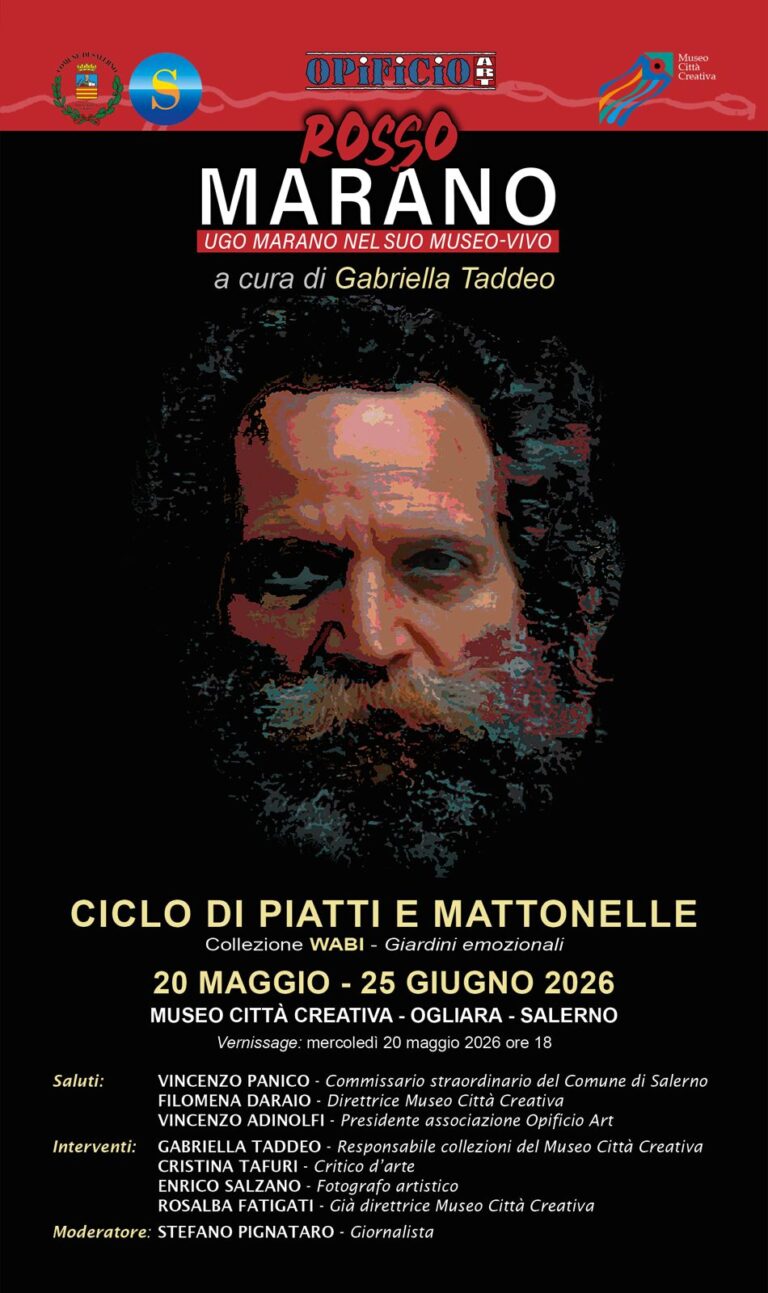
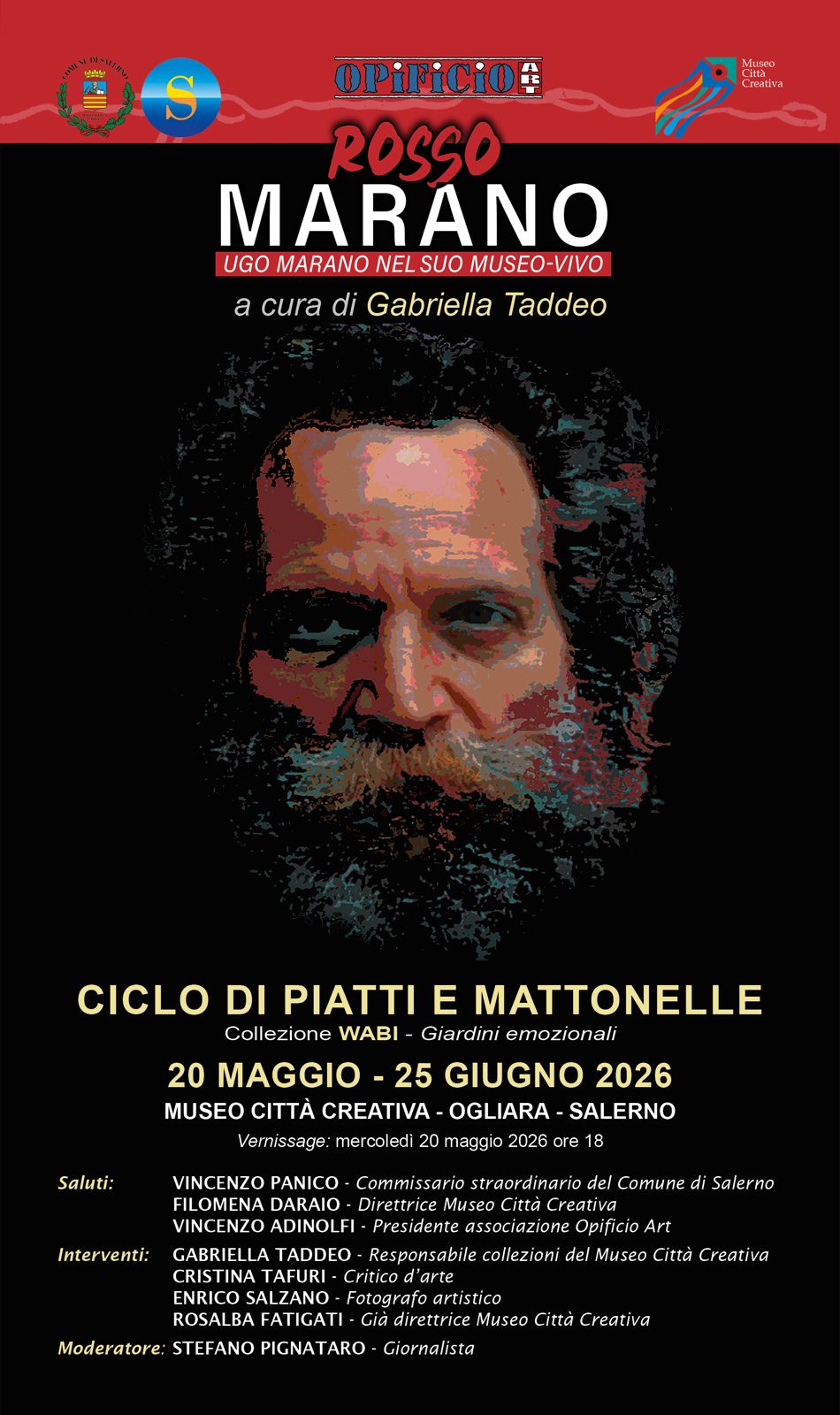
Ugo Marano in its Museo-vivo, curated by Gabriella Taddeo Ciclo di Piatti e Mattonelle. WABI Collection – Emotional Gardens. Vernissage: Wednesday 20 May 2026 hours 18.00
- Event
- Place
- Date/Hours
- Tickets
- Map
- Related Events
- Editions
- Programme
Tutti
Ogliara Creative City Museum
Rosso Marano
<<< THE MOSTRA IS PROROGED AT 31 JULY >>>
Cristina Tafuri
For Ugo Marano. Of land and fire
Ugo Marano has always been in contact with the four elements. He wanted to be in symbiosis with nature, to camouflage as a tree or become a whisk of the wind. The sea represented for Ugo Marano the amniotic liquid, was born and rebirth always, every time different as the waves of the sea that are never equal.
The sea, the limitless sea as Walt Whitman wrote, is the song of the mermaid that envelops our senses in the desire to belong totally to it. Marano often loved to go barefoot to warn the energy of the earth, to be part, root, stem, leaves, here is his relationship with the ceramic to which he gave value of art, to his totemic vessels that seemed to challenge the law of gravity for their extreme height.
In this symbiotic relationship with nature eros becomes the natural element, primigenic force, cosmic, according to the philosophical doctrine, a principle that tends to beauty, an ancient principle that concerns pulsion and sensuality.
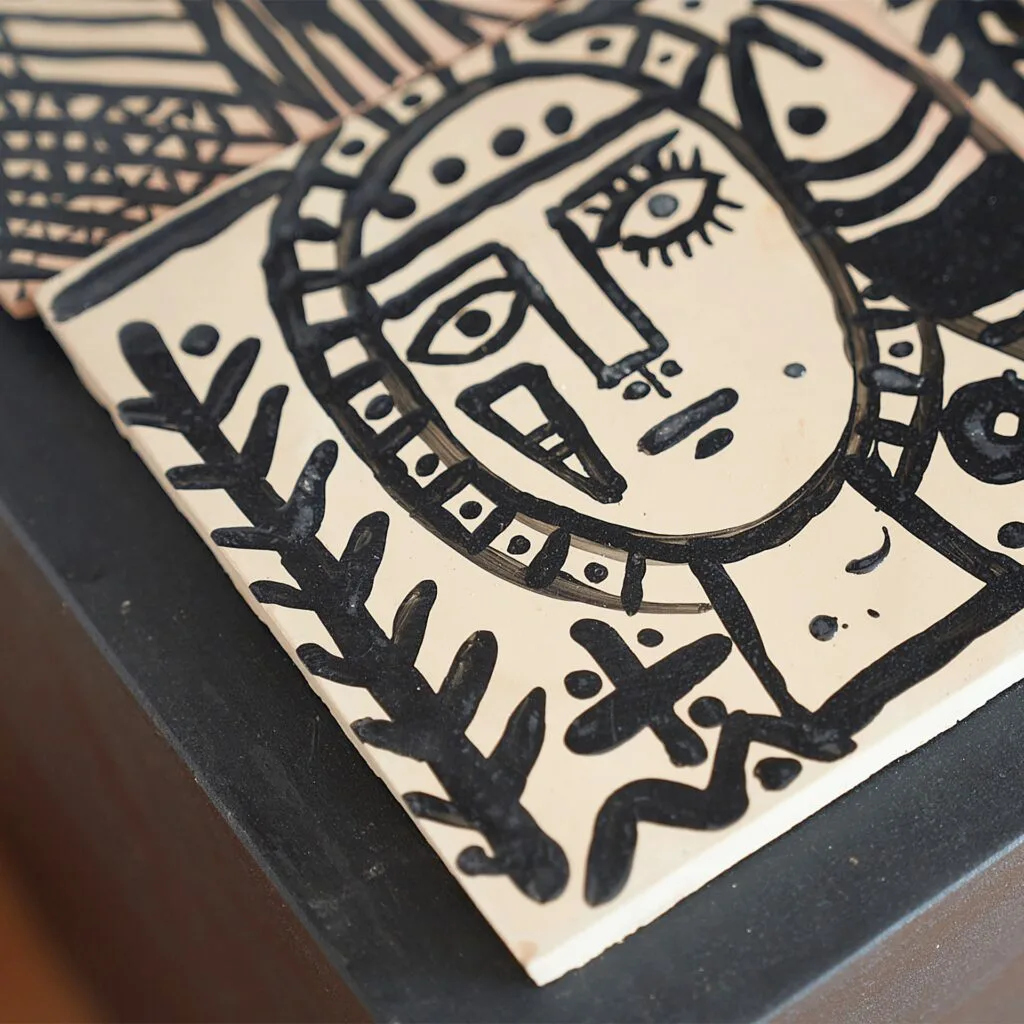
The clay is soft, warm, the pot becomes uterus, vagina, deep cavity that holds man, his sex. Formerly the peasants spread their seed into the earth to propitiate a generous harvest, the foul was totem, it was magic, it was life in the warm land that welcomed it. Imagine the long and great failures of the Roman hero, especially visible in the Domus Pompeiane. In these works by Ugo Marano on display at the Museo Città Creativa in Ogliara, the exuberance of these figures from the disproportionate failures emerges from the bright red of the color that covers the tiles and the dishes, almost to show of a desire that thrives powerfully with its sceptre of iron fire. And as Picasso reminds us of art and eroticism there is no difference.
Filomena Daraio
Director Museum Creative City
The Museo Città Creativa, in its new capacity of full accessibility thanks to the recent realization of the project “Removal of the physical and cognitive barriers” funded under the PNRR, reopens the doors to the exhibition activity that will be attached to the labs already in place. And this new beginning starts a small retrospective on the creator and first artistic director of this museum reality that goes to graft into the clay’s motherland always marked by the production and processing of terracotta. A ceramic identity that the Museum has always tried to maintain and also to encourage. Ugo Marano was excellent master in this atavica art he defined not minor art but queen art, mother of all the arts that emerges from all archaeological sites and allows to reconstruct the life of the people of the past and their ways of living. This artist also managed to synthesize in his most creative works that extend from drawing, ceramics to sculpture. I take this opportunity to reiterate the objectives of Creative City aimed first of all to preserve and value the identity of the place but also to give visibility and strength to all the artistic and craft ferments of thickness since the level of civilization of a territory is measured also and above all by the cultural richness that manages to mature and the artistic quality that enhances it. I thank those who have allowed this exhibition by making available the exhibition material that will allow the users to know a significant fragment of the vast production of Marano that continues to talk about him and his great creative and creative vein.
Gabriella Taddeo
Curator Show
Cetara’s vasal returns to speak to us in the rooms of the Ogliara Creative City Museum which was one of its creatures. The sequence of works on display follows the Eros as sacred transgression and pure energy that seeks ecstasy. It is the mind that speaks to the body and approaches him in his psychological and seductive game to awaken him beyond the limits of the Super-I and to experience the fullness of existence. They tell us these stylized beings from elongated and imaginary bodies without identity that come to life in his plates and on the area of his tiles. The same erotic allusivity is also in the depiction of the bird that found on his Fontana Felice. Red comes as an echo from the house of the Vetti and the other Pompeian houses coming to him that reinterprets it as selenium red and makes it absolutely contemporary, pushing towards the boundaries of language and inner experience. The chromium of red has always been and since the archaic times of the Greeks before and the Romans after, the archetype of fire as creativity, as art in particular ceramics but also as flame of passion, ardent heat that belongs to eros. In its traits it seems to resent the fragrant echo of the cantic cantic cantics that flaunts the two dialects on a readers of flowers and that celebrates sexuality as a divine gift in the encounter between two beings who merge. Ugo Marano had many faces; he was a pure artist in his completeness: designer, vassary, sculptor, performer. They called it “this visionary.” In the 1970s he was invited to exhibit at the Quadriennale in Rome, at the Venice Biennale and at the Triennale in Milan, in 1982 at the Centre Pompidou in Paris. In 1991 he was the leader of the group of “Vasai di Cetara” in his native land. In Salerno in 1996 he designed and built the Fontana Felice. Ugo Marano dies in 2011, and the production of works of art is currently preserved not only in “Casa Marano” in Capriglia but also in many museum spaces and in private places of collectors who over time have passionately believed in him. His poetics is outlined as an innovative vision that combines art, nature and civilization. Its approach is not only aesthetic, but ethical, aiming to safeguard the environment and to enhance dexterity. The artist often polemized against the lack of civic sense, and for him elegance does not reside in fashion, but in respect of nature, landscape and community. During the experience of the “Vasai di Cetara” (group created in 1991), Marano promoted a creative work free from dogmatic and academic schemes, giving ceramics the dignity of contemporary art. His designs defined them as “environmental thoughts” or messages related to landscape and matter. His poetics was also called “room of utopia”, where he is a mental abode and a space of free creation. “The frogs will come back to scratch” the artist hoped in the manifesto related to the economic utopia that maturò together with the economist Pasquale Persico and that he should relaunch the entire hilly area of Rufoli. And right there was born the Museo Città Creativa, in 1997 a space- workshop of ceramics for him mother of all the arts, unknown queen art. Marano believed in a living museum, necessary in a land always characterized by the processing of clay, dotted with furnaces and artisans as he reminds us himself in the text of his Manifesto: “In Rufoli di Salerno there is a country where there is a lot of good clay that transformed into terracotta assumes two very enviable characteristics the color embodied of child and the sweet and timbre sound of bell. In this country there are many furnaces that in the past have given work to the people of the place and provided tiles to the ceramists of Vietri Sul Mare who have gracefully decorated them to adorn churches and houses.”
Museum Creative City Museums and Archaeology Museo Città Creativa di Ogliara, Via di Ogliara, Salerno, SA, ItaliaGratuito
Tutti
— Exhibition extended until July 31 —
Event News
There is no news for this event.