• Home
  • Salerno
    • History of Salerno
    • Historical Figures
    • Traditions
    • Food and Wine
    • Mobility in Salerno
    • Places Nearby
    • Useful Links
  • Events
    • Find an Event
    • Artist Lights
    • Must-see events 2026
  • Explore places
    • Itineraries
    • Verdi Theater
      • Theater Home
      • The season 2026
      • The Prose Season 2026
      • Ticket office
    • Cultural Venues and Theatres
    • Churches and Monasteries
    • Palaces and Squares
    • Museums and Archaeology
    • Gardens and Parks
    • Modern Architecture
  • News
  • English
    • English
    • Italiano
    • Français
Salerno Cultura -
  • Home
  • Salerno
    • History of Salerno
    • Historical Figures
    • Traditions
    • Food and Wine
    • Mobility in Salerno
    • Places Nearby
    • Useful Links
  • Events
    • Find an Event
    • Artist Lights
    • Must-see events 2026
  • Explore places
    • Itineraries
    • Verdi Theater
      • Theater Home
      • The season 2026
      • The Prose Season 2026
      • Ticket office
    • Cultural Venues and Theatres
    • Churches and Monasteries
    • Palaces and Squares
    • Museums and Archaeology
    • Gardens and Parks
    • Modern Architecture
  • News
  • English
    • English
    • Italiano
    • Français
Salerno Cultura -
  1. Home
  2. Eventi
  3. Theatre
  4. Teatro Arbostella – Il Pidocchio

Teatro Arbostella – Il Pidocchio

a payment Arbostella Theater 24 Oct 2026 – 8 Nov 2026

Teatro Arbostella – Il Pidocchio
Theatre

Descrizione breve

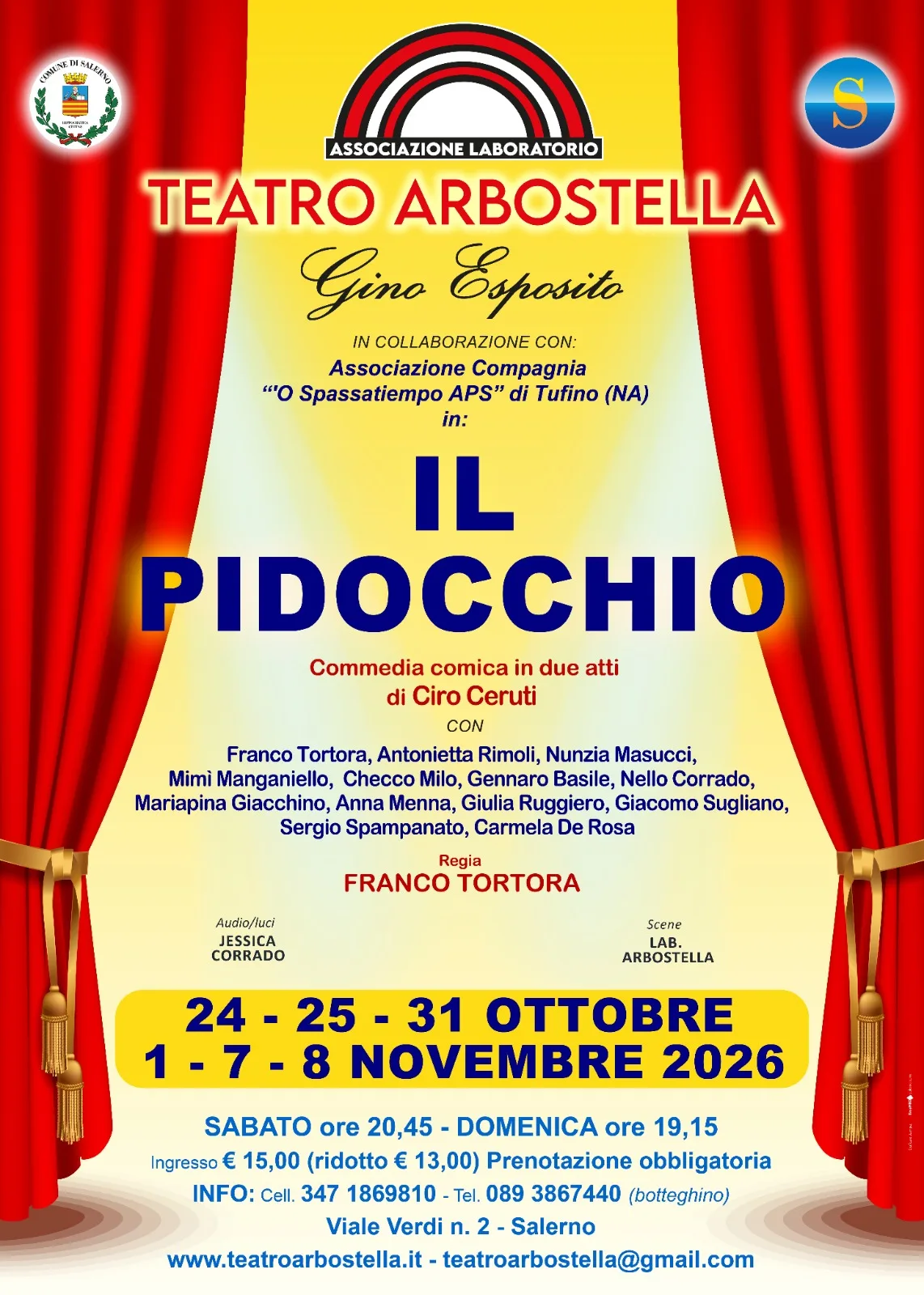
For the 19th season of the Teatro Arbostella "Gino Esposito" of Salerno, appointment with "Il Pidocchio".

Share
Send

    Photo credits: Organizzatore evento

    • Event
    • Place
    • Date/Hours
    • Tickets
    • Map
    • Related Events
    • Editions
    • ♪


    Target

    all


    Owner

    Teatro Arbostella Gino Esposito


    Phone
    0893867440
    Phone 2
    3471869810
    Phone 3
    3282664758

    Email
    teatroarbostella@gmail.com

    Web Site

    www.teatroarbostella.it


    Description

    Teatro Arbostella – Il Pidocchio


    Teatro Arbostella, here is the exhilarating “Il Pidocchio” by Ciro Ceruti: on stage the company ’O Spassatiempo


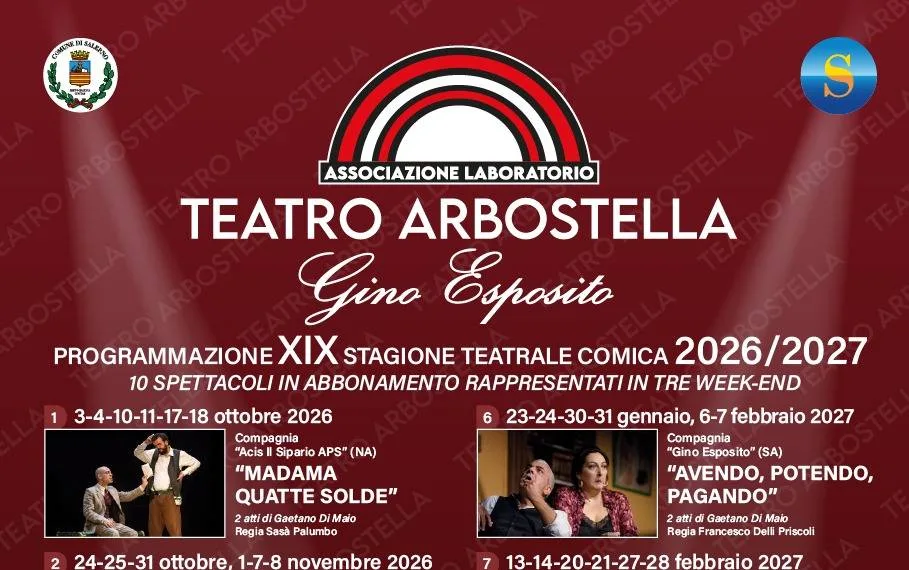
    After a record season opening, with over 600 subscriptions, the Teatro Arbostella “Gino Esposito” is ready to welcome the second appointment of the 19th theatrical season 2026/2027.


    On the stage of Viale Verdi arrives the theatrical company ’O Spassatiempo, coming from Tufino, in the province of Naples, with the comedy “Il Pidocchio”, text signed by Ciro Ceruti and directed by Franco Tortora, who will also be protagonist of the show.


    The company returns for the second consecutive year in the Arbostella poster, after the positive feedback obtained in the past season. A confirmation that fits into the artistic path carried out by Arturo Esposito and Imma Caracciuolo, artistic and organizational directors of the theatre, with a programming that focuses on comedy, alternating texts of tradition and contemporary proposals, without sacrificing content and ideas of reflection.


    In the middle of the pitch there is one of the oldest and most recognizable human vices: greed. The liceo, a small parasite entered the collective imagination as a symbol of tirchieria, thus becomes a theatrical metaphor of morbid attachment to money, but also of naivety and pettyness. A theme that crosses the history of the theatre, from the Latin comedy of Plauto, with the forefather protagonist of the “Aularia”, up to the Aragon of Molière and his famous masterpiece “L’avaro”, in which the craving of wealth affects human relationships and alters every family balance. A gallery of characters coming to the “Cavaliere avaro” of Puškin, where possession of money becomes an authentic obsession.


    With “Il Pidocchio”, Ciro Ceruti resumes this thread and rereads it through Neapolitan sensibility and culture. The perspective proposed by Franco Tortora goes beyond the simple stereotype of the taccagno: in the popular Neapolitan mentality, in fact, greed does not necessarily coincide with the will to do evil. Even the character most attached to money can reveal, in decisive moments, a surprising generosity, especially when health and family affections come into play. It is precisely this contradiction to make the comedy particularly interesting: behind the seemingly mean behavior of the protagonist hides a universe of relationships, feelings and weaknesses that comedy brings to light, alternating paradoxical situations and moments of reflection.


    The choice of the text arises from an artistic meeting that Tortora remembers with particular pleasure. The actor and director tells that he has witnessed the performance of the comedy, over fifteen years ago, by a group of friends, remaining immediately impressed. Since then he has matured the desire to re-propose it, convinced that the vices and human virtues, fallen into Neapolitan culture and artistic tradition, can assume original meanings and far from the usual clichés.


    Franco Tortora’s curriculum is not just theatre. The actor took part in important film and television productions, including the Pizzofalcone bastards, the third season of Gomorra, Pericle the Black, with Riccardo Scamarcio, and the most recent Parthenope by Paolo Sorrentino, in which he plays the role of a priest in one of the most delicate scenes of the film. Different experiences, however, have not attenuated its connection with the stage. For Tortora, the theatre preserves a particular human dimension: the direct relationship with the public, the possibility to perceive its reactions in real time and that component of authenticity that makes every representation an unrepeatable experience. Next to Tortora will climb on the stage a numerous cast composed by Antonietta Rimoli, Nunzia Masucci, Mimì Manganiello, Checco Milo, Gennaro Basile, Nello Corrado, Mariapina Giacchino, Anna Menna, Giulia Ruggiero, Giacomo Sugliano, Sergio Spampanato and Carmela De Rosa.


    Date, schedule, tickets


    Dates and times: shows are scheduled on weekends 24, 25, 31 October, 1, 7 and 8 November 2026, with performances on Saturday at 20.45 and Sunday at 19.15.


    Tickets are available at the cost of15 euro, with reduced to13 euro.


    For information and reservations: 347 1869810 – 089 3867440


    mail:theaterarbostella@gmail.com

    Connected Places
    Arbostella Theater Cultural Venues and Theatres Teatro Arbostella “Gino Esposito”, Viale Giuseppe Verdi, Salerno, SA, Italia

    Start Date

    24 October 2026


    End Date

    8 November 2026


    Price

    a payment


    Target

    all


    Altre informazioni


    Open in Maps

    teatro-arbostella-2026-2027-locandina

    Event News

    There is no news for this event.

    Comune di Salerno
    Via Roma – Palazzo di Città, 84121 Salerno
    C.F. 80000330656 P.IVA 00263650657

    Email:
    cultura@comune.salerno.it

    Reporting service disruptions on the portal:
    utd@pec.comune.salerno.it

    Explore Places

    • Itineraries
    • Cultural Venues and TheatresCultural venues and theatres in Salerno enliven the city’s artistic life with a dense network of historic halls and contemporary spaces dedicated to theatre, cinema, music and performing arts. From the Municipal Theatre Giuseppe Verdi and the Cinema Teatro Augusteo to the Teatro Ghirelli, Sala Pasolini and neighbourhood theatres such as Teatro delle Arti, Piccolo Teatro del Giullare and Teatro Nuovo, these spaces host seasons, festivals, workshops and projects that make culture accessible to residents and visitors all year round.
    • Churches and MonasteriesThe churches and monasteries of Salerno preserve the spiritual and historical heart of the city, especially in the old town centre, where monumental buildings and more intimate spaces tell centuries of faith and art. From the Cathedral of San Matteo to the monastic complexes of San Benedetto, Santa Sofia and San Giorgio, a journey through these sites crosses different eras — from medieval and baroque architecture to spaces now repurposed for culture — keeping alive the connection with the religious roots of the territory.
    • Palaces and SquaresPalaces and squares in Salerno form a vibrant urban fabric, where noble residences, historical archives and monumental spaces recount the city’s civil and social evolution from the Middle Ages to the twentieth century. From Piazza Portanova and Largo Campo to Piazza Abate Conforti, from Palazzo Fruscione to the City Hall and the many historic buildings along Via dei Mercanti and in the Duomo district, every corner offers evocative architectural settings that combine history, everyday life and the symbolic places of the Salerno community.
    • Museums and ArchaeologyMuseums and archaeology in Salerno recount the thousand-year history of the territory through artefacts spanning from prehistory to the Roman era, housed in a network of institutions spread across the city. From the Provincial Archaeological Museum, hosted in the former monastery of San Benedetto and dominated by the famous bronze head of Apollo, to civic and diocesan museums and the routes dedicated to the Etruscan-Samnite sites of Fratte, each exhibition offers an immersive journey through everyday objects, funerary goods, sculptures and the evidence of ancient civilisations in the Salerno area.
    • Gardens and ParksGardens and parks in Salerno offer a widespread network of green areas stretching across the entire city — from historic gardens to large urban parks — creating spaces for relaxation and socialising just steps from the sea. From the Parco del Mercatello to the Parco del Seminario, from the Parco dell’Irno to the gardens of the eastern district and the Giardino della Minerva, these places combine nature, outdoor sports and cultural events, enhancing the urban landscape and making the city more liveable in every season.
    • Modern ArchitectureModern architecture in Salerno reshapes the relationship between the city and the sea with iconic buildings and open public spaces, transforming the waterfront into a new contemporary urban hub. From the Crescent and Piazza della Libertà to Zaha Hadid’s maritime station, the Santa Teresa seafront and the Cittadella Giudiziaria, a dynamic architectural landscape emerges — one of fluid lines, essential volumes and sea-facing squares designed for the social and cultural life of the city.

    Events

    • Concerts
    • Dance
    • Exhibitions
    • Fairs
    • Festivals & Series
    • Music
    • Opera
    • Festivals & Series
    • Theatre

    Salerno

    • Historical Figures
    • Food and Wine
    • Mobility in Salerno
    • Places Nearby
    • Useful Links

    © 2026 Comune di Salerno – All rights reserved

    • Credits
    • Privacy Policy
    • Cookie Policy
    • Accessibility statement
    • Instagram
    • Facebook